Book review
Stolen Focus, by Johann Hari
Are you fed up doom-scrolling? Do you find it difficult to read long documents that you could previously? Do you find yourself flitting between tasks?
Read our review of Stolen FocusBook review · 1 October 2026 · 3 min read
by Rosamund Stone Zander and Benjamin Zander
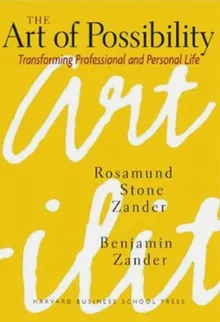
What do music and transformational coaching have in common?
Well, quite a few things, actually. But the most prominent thing they have in common are the authors of “The Art of Possibility” – Rosamund Stone Zander and Benjamin Zander. Roz is a therapist, coach and facilitator and her husband, Ben is the conductor of the Boston Philharmonic Orchestra.
In this book they explore “the art of possibility”. Ben shares some of his less-than-conventional teaching techniques, developed in consultation with his wife, which are referred to as 12 Practices:
Throughout the book they use stories and parables to explain the concepts. Many of them are set in examples of practice and performance of adult and teenage orchestras. Here are some of my favourites:
From chapter 1: “A shoe factory sends two marketing scouts to a region of Africa to study prospects for expanding business. One sends back a telegram saying, SITUATION HOPELESS STOP NO ONE WEARS SHOES. The other writes back triumphantly, GLORIOUS BUSINESS OPPORTUNITY STOP THEY HAVE NO SHOES.”
Chapter 3 introduces a concept that runs throughout the book – Ben gets his students to write a letter as themselves at the end of the course explaining why they got an A grade. It opens the possibility that they will and will deserve to.
In Chapter 6, the Calculating Self (ever fighting for survival in a selfish way) and the Central Self (a fulfilled, aware and fluid being) are used to show how negotiation can be mutually beneficial if the parties look beyond themselves.
Chapter 10 is not about being the Board of Directors but about being the Board of a Board game rather than a participating piece. It is a way of saying “I am the framework for everything that happens in my life”.
The Art of Possibility that runs throughout the text is the ability to avoid being drawn into a “downward spiral” of negativity and instead to identify the dream, to contribute to its achievement, to lead from any position and to spark enthusiasm in others.
A quote from chapter 11: “The foremost challenge for leaders today, we suggest, is to maintain the clarity to stand confidently in the abundant universe of possibility, no matter how fierce the competition, no matter how stark the necessity to go for the short-term goal…It is to have the courage and persistence to distinguish the downward spiral from the radiant realm of possibility in the face of any challenge.”
This book challenged me to articulate my personal Vision. My Vision is to work with others in their pursuit of reaching their full potential. The art of possibility as conveyed in this book is a central concept to my coaching and the WE explored in Chapter 12 is the idea that, in coaching, it is not a “you” and “me”. Collaboration, learning and coaching only works if “WE” are pulling in the same direction as the path presents itself rather than trying to get to predetermined or prejudged outcomes.
And where does the Tristan Chord fit in to all this? Well, if you know you know. Oh, and if you’re wondering what Rule Number 6 is, it’s to never take yourself too seriously.
If you are intrigued and would like to explore the art of possibility in your career, please get in touch with us at D3 Partnership and WE will achieve great things!
Samantha Peat, Executive Coach
Book review
Are you fed up doom-scrolling? Do you find it difficult to read long documents that you could previously? Do you find yourself flitting between tasks?
Read our review of Stolen FocusBook review
Do you need help in making sense of your feelings and what you can do about them?
Read our review of Active HopeBook review
Can coaching help to harness our inner voice? At D3 Partnership, we believe there are methods and tools available to do this. We work with clients to identify Performance Inhibiting Thoughts and turn…
Read our review of Chatter